the practice of journaling
eight journaling books worth reading
the popular canon agrees journaling matters and disagrees on everything else. eight books, seven styles, plus the science of why they all work.
the canon disagrees about everything except that it works
The popular journaling canon is a strange shelf. The Artist's Way and The Bullet Journal Method sit on the same end-cap at the bookstore, but they do not agree on what a journal is for, what time of day to write, what to write about, or whether the writing should ever be read again. The shelf includes a thirty-year-old spiritual guide, a working illustrator's nature notebook, a structured-diary handbook from 1978, a twenty-two-step therapy manual, and a productivity system written by a guy with ADHD. Then in the corner, mostly unread by general readers, there is the one academic book that explains why any of these styles work at all.
A search for "best journaling books" returns roughly the same eight titles, ranked in roughly the same order, on roughly every roundup. Nobody who reads more than two of them keeps reading. The books contradict each other so completely that following all of their advice at once produces nothing. There is no best journaling book. There is the book whose method matches the writer who is reading it, and the science that explains why the match matters more than the choice.
eight books, seven styles, one shelf
There are seven distinguishable styles in the popular journaling literature. Free or generative writing, where the goal is to dump material onto the page and stop fighting it. Structured or therapeutic journaling, where the page is a clinical instrument with named exercises and protocols. Terse or operational logging, where the journal is a productivity layer for tasks, calendar entries, and collected thoughts. Spiritual witness, where the journal is a contemplative practice closer to prayer than to therapy. Visual or nature journaling, where text and drawing share the spread and the content is the world outside the writer rather than the writer's own interior.
The eight books below cover all seven styles, and the eighth book is the one that explains why none of them is wrong. Reviews are stacked in the order the style-arc moves through them, not by quality.
The Artist's WayA Spiritual Path to Higher Creativity
Cameron · 1992 · Jeremy P. Tarcher/Perigee
the morning-pages bible. polarising, influential, still the reference point.
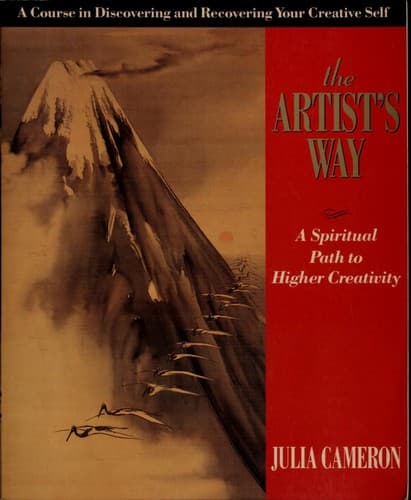
The book that taught a generation of blocked artists to write three longhand pages every morning before doing anything else. Cameron's morning pages protocol is the closest thing the field has to a single, transferable technique: roughly 750 words, by hand, on waking, without rereading or editing, every day. The mechanism Cameron names is unblocking, by which she means clearing the surface chatter so deeper material can come through. The mechanism a behavioural scientist might name is something more boring, like attentional reset or expressive depletion. Either framing produces the same protocol.
The book itself is twelve weeks of exercises, prayers, artist dates, and reflective prompts that some readers find essential and others find embarrassingly woo. The morning-pages technique survives that disagreement intact, which is the rare gift of a book whose central protocol is portable out of its frame.
Leap, and the net will appear.
Writing Down the BonesFreeing the Writer Within
Goldberg · 1986 · Shambhala
the zen of timed writing practice. messy, generous, still the gateway drug.
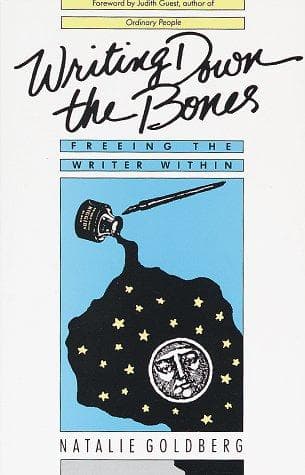
Goldberg's instructions are the smallest viable journaling practice that calls itself something other than journaling. Set a timer. Keep your hand moving. Do not cross out. Do not edit. Lose control. Be specific. The discipline is borrowed from her Zen practice, and the voice on the page is unmistakably hers, but the mechanics generalise cleanly to any private notebook. The book repeats this small handful of rules in dozens of short chapters from dozens of angles, which is its method as much as its message: the same idea, returned to and returned to, until it is internalised.
The line Write what disturbs you, what you fear, what you have not been willing to speak about. Be willing to be split open. is the sentence the rest of the book is trying to earn. It mostly does. For generative writing it is the cleanest single-volume guide in print.
The New DiaryHow to Use a Journal for Self-Guidance and Expanded Creativity
Rainer · 1978 · J. P. Tarcher
the structured-diary handbook. underread, still the clearest map.
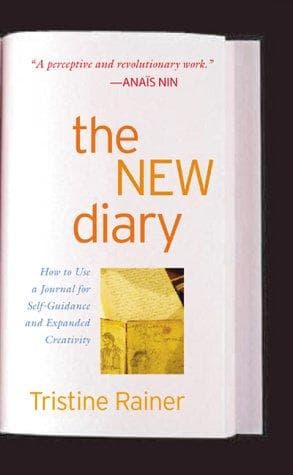
Rainer's 1978 handbook is the underread sibling to all the books that came after. It is the first popular guide to systematise journaling as a set of named techniques: catharsis, description, free intuitive, reflection, dialogue, altered point of view. Adams later expanded the list to twenty-two; Rainer's compact six already covered most of the field. If structured therapeutic journaling appeals more than the morning-pages flood, this is where it started.
Journal to the SelfTwenty-Two Paths to Personal Growth
Adams · 1990 · Warner Books
the founding therapist's toolbox: 22 named techniques you can actually pick up and use.
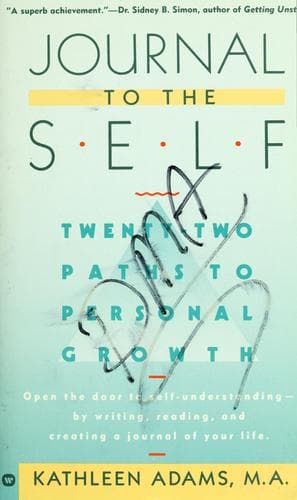
Where Rainer is a treatise, Adams is a clinic. Journal to the Self came out of her training programme at the Center for Journal Therapy in Denver, and the book reads like a structured workbook with a therapist's voice on every page. Twenty-two named techniques, each introduced with a short rationale, a sample, and an exercise. The sentence stem, the captured moment, the unsent letter, the dialogue. The technique inventory is the value here. Treat the book as a reference and pull from it as a particular session calls for.
A reader who finds the morning-pages flood unstructured and the bullet journal too operational will find their middle ground in this book. The signature framing, a friend at the end of your pen, captures the relational stance the techniques invite.
The Bullet Journal MethodTrack the Past, Order the Present, Design the Future
Carroll · 2018 · Portfolio
the analog system that started a movement. rapid logging, migration, intention.
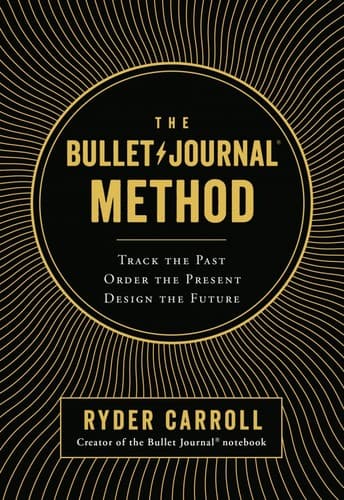
Carroll's system began as an analog productivity hack and grew into something stranger and more interesting. The mechanics are the mechanics: a key, an index, monthly and daily logs, rapid-logging notation, migration. The deeper claim is that the act of moving an unfinished task forward by hand, week after week, surfaces what is worth doing and quietly retires what is not. Carroll calls this reflection; a behavioural economist might call it forced re-evaluation. The mechanism is the same.
The book is half method, half memoir, and the memoir half is where Carroll is most candid about the role his ADHD played in the system's emergence. For readers whose brains do not file ideas linearly, this is the canonical reference. For readers who already journal narratively and want a parallel layer for tasks and calendar, the system bolts on without disturbing the prose.
The Bullet Journal method will help you accomplish more by working on less. It helps you identify and focus on what is meaningful by stripping away what is meaningless.
Life's CompanionJournal Writing as a Spiritual Quest
Baldwin · 1990 · Bantam
the gentle, root text for treating a journal as quiet spiritual practice.
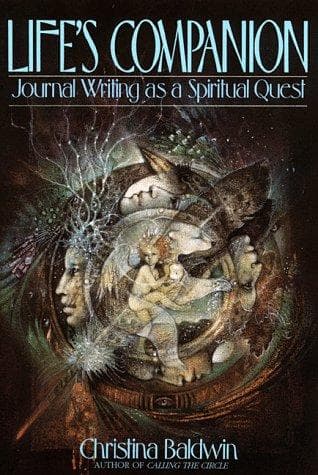
Baldwin's book is the spiritual end of the popular shelf. Where Adams and Rainer treat the journal as a therapeutic instrument, Baldwin treats it as a contemplative practice closer to a daily examen than to a clinical protocol. The vocabulary, witness, quest, sacred attention, will land for some readers and feel inaccessible to others. The exercises that anchor the book are simpler than the spiritual framing suggests, and they survive translation into a more secular practice. Worth reading by the segment of writers for whom therapy is the wrong frame and prayer is too narrow a one.
A Trail Through LeavesThe Journal as a Path to Place
Hinchman · 1997 · W.W. Norton
an illustrated nature-journal manifesto that treats place as the practice.
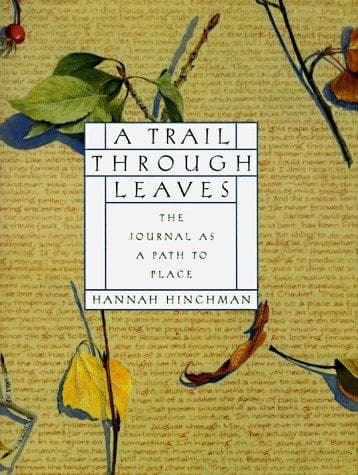
The most physically beautiful of the eight. Hinchman is a working illustrator, and her trail is a journal in which prose, ink drawings, and watercolour share every spread. The book is part field-guide, part manifesto for the journal as a tool of attention to place. For readers whose journaling instinct is to record the world rather than the self, this is the book the rest of the canon does not quite cover. The argument is that what you draw, you see, and the practice it recommends is closer to a naturalist's notebook than to a diary. Out of print on most retailers and worth tracking down second hand.
Opening Up by Writing It DownHow Expressive Writing Improves Health and Eases Emotional Pain
Pennebaker, Smyth · 2016 · Guilford
the science outlier. expressive-writing trials from the researcher who started the field.
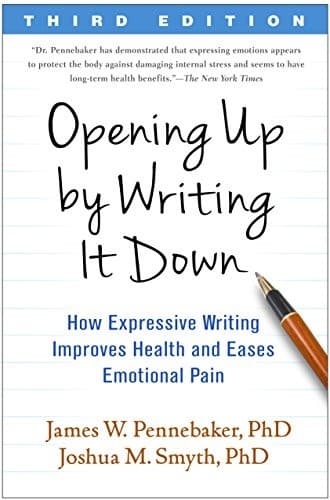
The seven books above tell the writer what to do. Pennebaker tells the writer why any of it works. Opening Up by Writing It Down is the trade-press summary of forty years of expressive-writing research, beginning with the 1986 trial in which forty-six undergraduates wrote about a personal trauma for fifteen minutes on four consecutive evenings and visited the campus health centre roughly half as often six months later.[1] The book traces the finding through replications, meta-analyses, and the slow narrowing of the original claim. By Smyth's 1998 meta-analysis the effect on health outcomes was real, modest, and considerably smaller than the early enthusiasm.[2] The book is honest about that shrinkage and more interesting because of it.
The reason this volume sits at the end of the list is that the seven books above describe protocols. This one describes the underlying mechanism. It is the only entry on the shelf where the question does this work is treated as an empirical question rather than a rhetorical one. Read it after one of the practice-side books has already given you a notebook and a habit.
pick a style first, then a book
The mistake the popular roundups make is treating these eight books as ranked alternatives. They are not. A reader who finds Cameron's morning pages essential is not a failed Bullet Journal user, and a Carroll reader is not a failed contemplative. The seven styles solve different problems, and the choice between them is a choice about what kind of writer the reader already is, not a choice about which author is most correct.
A reader stuck on which to start should pick by friction. The book that most resists being put down after twenty minutes is the one whose method matches the reader's grain. The other six can wait or never be read at all. The Pennebaker is the exception, worth reading regardless of style because it is the only one that explains why a notebook the reader keeps for forty days will outperform any notebook the reader buys and abandons.
The popular canon's only point of agreement is that journaling matters, and even that survives the contradictions only because the underlying mechanism is robust to the choice of method. Match the book to the kind of attention the reader can already pay, and the rest of the shelf can stay on the shelf.
These eight books are one slice of a much longer shelf. The dated, one-line log has a thousand-year tradition behind it, well outside the bookshop canon, and that history is part of the practice of journaling the books only partially describe.
references.
- 1.Pennebaker, J.W. & Beall, S.K. (1986). Confronting a traumatic event: Toward an understanding of inhibition and disease. Journal of Abnormal Psychology 95(3), 274–281.doi:10.1037/0021-843X.95.3.274
- 2.Smyth, J.M. (1998). Written emotional expression: Effect sizes, outcome types, and moderating variables. Journal of Consulting and Clinical Psychology 66(1), 174–184.doi:10.1037/0022-006X.66.1.174
related.
- where to start journalingthe popular roundups rank eight books. a beginner needs one. why goldberg's bones is the cleanest entry into a notebook habit.
- a thousand years of micro-journalingthe dated log was the default for a thousand years. heian nikki, locke's index, pepys's daily entries, today's one-line apps. one continuous shape.
- twelve journaling podcast episodes worth your commuteno podcast is worth subscribing to for journaling. twelve specific episodes are. researchers, writers, and one prescriptive host.